 Kinyarwanda
 Oshiwambo
 Tagalog
 Punjabi
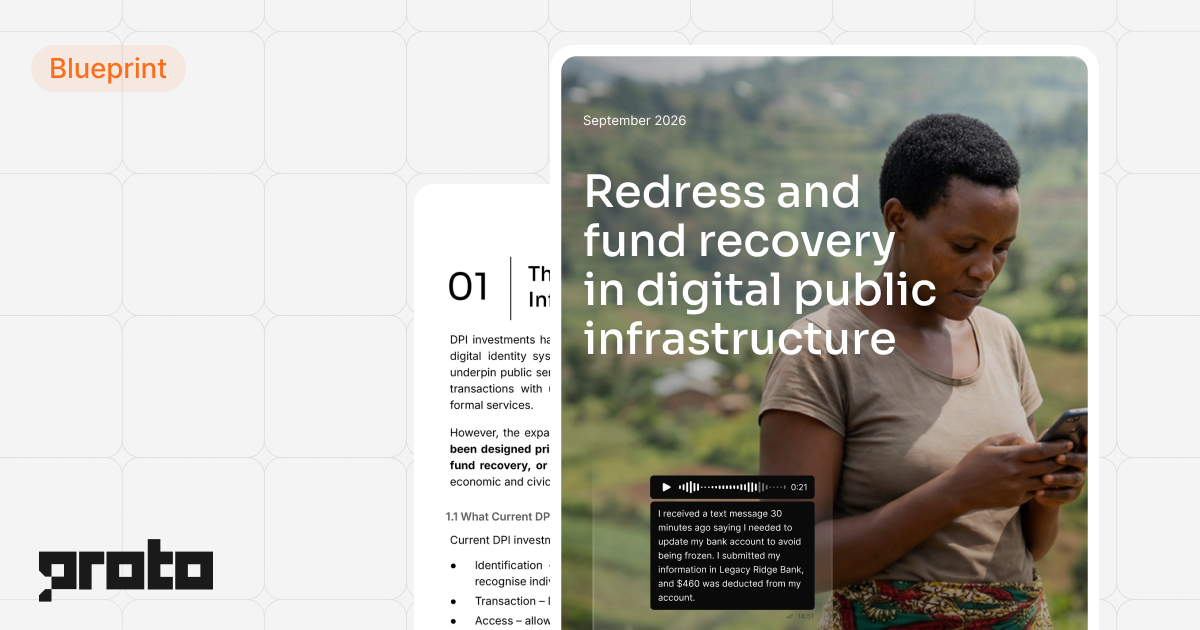
Abstract
This blueprint sets out a sustainable trust layer within digital public infrastructure (DPI): the systems with which citizens seek redress, and through which lost funds are traced, frozen, and recovered. Bilateral and philanthropic donors have funded DPI technology that has expanded access to financial services for over 1.1 billion citizens across low- and middle-income countries (LMICs), but that access has been systematically exploited by transnational criminal networks – global scam losses reached an estimated US$579.4 billion in 2025. Drawing on live AI-based redress deployments across Africa and Asia, on national anti-scam utility design, and on country case studies from Pakistan and Namibia, this blueprint sets out three integrated functions – redress, recovery, and instant payment system integration – together with a phased stakeholder strategy and a liability waterfall model for long-term sustainability. It is intended as a guide for regulators and government agencies, development partners, and philanthropic organisations seeking sustainable models to ensure trust in digital systems.
“The challenge right now is, whose baby is this?”
Rajesh Bansal
Former CEO, Reserve Bank of India Innovation Hub, on anti-scam system ownership between regulators, police, and financial institutions
Authors
.png)

Curtis is the founder of Proto, a social enterprise that deploys inclusive AI redress systems across low- and middle-income countries, such as Rwanda and the Philippines.
Kimmo is the founder of FNA, a financial network analytics innovator that specialises in track-and-trace technology for national fraud portals, such as Malaysia, Indonesia, and the UAE. He led the G20-awarded Trust at Speed integrated redress and recovery system.
Three integrated functions
- A trust layer for LMIC instant payment systems – zero-cost grievance intake across messaging, SMS, and voice channels, with AI-mediated resolution, auto-escalation for scam reports, and real-time cross-institution fund tracing and freezing.
- A stakeholder strategy for new anti-scam utilities – a phased establish, scale, sustain sequence that moves fast with the smallest workable coalition, then widens it as performance becomes defensible, so no single participant can structurally veto implementation.
- A liability waterfall model for long-term sustainability – informed by reimbursement frameworks in the UK, Singapore, and Australia, assigning first, second, and third-pay responsibility across case types, with a pre-funded protection pool so low-income consumers never bear the cost.
Key takeaways
These key takeaways are grounded in evidence from live national deployments and focus on practical design choices that determine whether digital systems build long-term trust or expose new systemic risks.
- Citizen redress and fund recovery are no longer optional add-ons – they are core infrastructure required to sustain trust in scaled digital public systems, alongside identity and payments.
- Global scam losses reached an estimated US$579.4 billion in 2025, and in several LMICs studied, none of the scam reports processed by regulatory AI agents resulted in successful fund recovery.
- A trust layer of three integrated functions – redress, recovery, and instant payment system integration – can resolve grievances and trace, freeze, and recover consumer funds within the 24-hour window in which recovery remains feasible.
- A phased stakeholder strategy – establish, scale, sustain – sequences engagement from the smallest workable coalition through to permanent governance and funding, so that no single participant can structurally veto implementation.
- A liability waterfall model, informed by reimbursement frameworks in the UK, Singapore, and Australia, assigns first, second, and third-pay responsibility across case types, with a pre-funded protection pool so low-income consumers never bear the cost.
- Country case studies from Pakistan and Namibia show how a donor-funded pilot can transition to a self-sustaining model – for example, a prospective success fee on recovered funds that would fund thousands of social-protection grievance cases each year.
- Development funding has the greatest impact when it acts as a catalyst – establishing durable public capacity that transitions to shared-service and domestic financing models.