 Kinyarwanda
 Oshiwambo
 Tagalog
 Punjabi
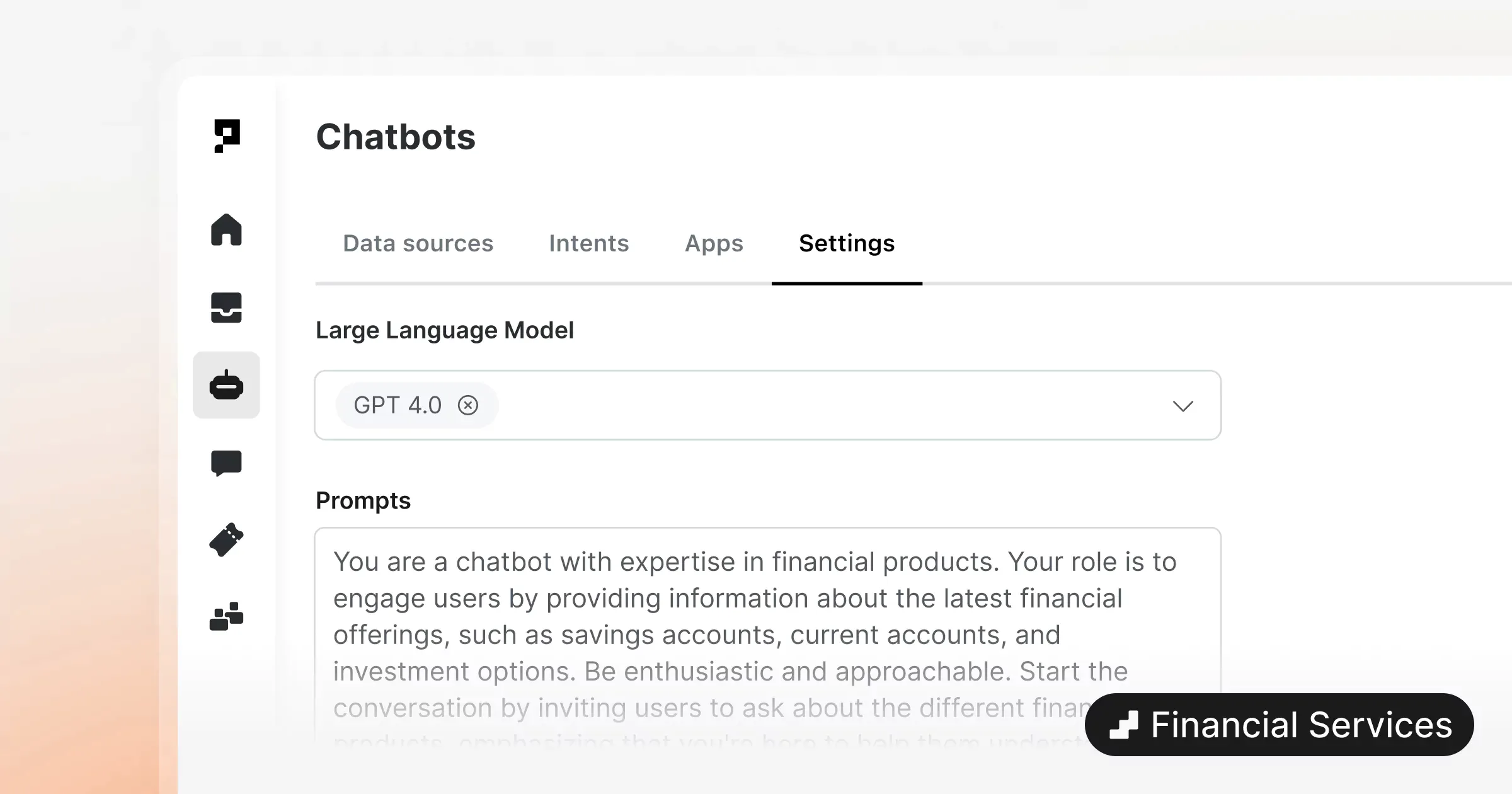
Precise, well-designed prompts are the foundation of any effective AI agent in financial services. Our partnerships with Universal Storefront Services Corporation in the Philippines and Bitflex in Malaysia are prime examples of how integrating conversational AI in banking and financial services can meaningfully improve customer experience – but only when the agent is properly configured.
That configuration starts with the prompt.
When you build an AI agent on Proto’s platform, the system prompt is the instruction layer that defines how the agent communicates: its tone, its scope, what it will and won’t say, and how it handles the sensitive situations that arise constantly in finance. A well-written prompt shapes a general-purpose LLM into a focused, reliable banking virtual assistant or financial services AI agent that customers can actually trust.
In this article, we explain how to write effective prompts for financial services AI agents and share five examples – each with a system prompt and a sample agent output – that you can adapt for your own deployment.
How to write good prompts for financial services AI agents
A prompt is not just a greeting or a conversation starter. In Proto’s platform, the system prompt is a set of instructions that tells the LLM how to behave across every interaction – not just the first one. The quality of that instruction set determines whether your banking AI agent builds customer confidence or erodes it.
Here are five practices that make a significant difference in financial services:
Understand the agent’s role and limits
The first step is being clear about what your AI agent is – and is not – there to do. A banking AI agent handling account enquiries has a very different remit from a virtual assistant banking customers through a loan application. Define the scope explicitly in your prompt so the LLM knows where its authority begins and ends. This is especially important in regulated contexts, where straying into personalised financial advice or making commitments outside your agent’s authorisation can have real consequences.
Define your objective clearly
Before writing a prompt, establish the primary goal of the interaction. Is the agent there to reduce inbound call volume? To support a specific product journey such as a loan application? To handle complaints on behalf of a regulator? Knowing the objective shapes the structure and tone of every instruction you write.
Keep instructions specific and unambiguous
Overly vague instructions produce inconsistent responses. Rather than telling the agent to “be helpful”, specify what helpful looks like: collect these details in this order, always include this disclaimer, never ask for this type of information. The more precisely you write the prompt, the more predictably the agent behaves – which matters enormously in an environment where accuracy and consistency are non-negotiable.
Anticipate where the conversation could go wrong
Financial conversations can escalate quickly – a routine balance enquiry can reveal a suspected fraud, a product query can turn into a complaint. Good prompts anticipate these shifts and define explicit escalation triggers: the specific conditions under which the agent should offer a live agent handoff, stop answering independently, or direct the customer to a secure channel.
Account for multilingual needs
If your platform serves customers across multiple languages or markets – as Proto’s does across the Philippines, Africa, and beyond – your prompt needs to address how the agent handles language switching. Specify whether the agent should follow the customer’s language or stick to a configured default, and ensure any mandatory disclosures or compliance language is reviewed for accuracy across all supported languages.
5 AI agent prompts for financial customer experience
Each example below combines a system prompt – the instruction you configure on Proto’s platform – with a sample agent output, showing how the two relate in practice. These prompts work alongside a knowledge base (your product documentation, FAQs, policies, and compliance materials) and structured workflows for transactional interactions.
1. General enquiries and account information
System prompt:
You are a customer support agent for [Financial Institution]. You help customers with general account questions, including balance enquiries, recent transaction summaries, account product information, and basic service requests. You must never ask for or repeat a customer’s full account number, card number, password, or PIN. If a customer needs to verify their identity or access specific account details, direct them to [secure verification channel or URL]. If a question falls outside your knowledge base, say so clearly and offer to connect the customer with a live agent. Keep responses factual and concise.
Sample agent output: “Hello! How can I help you today? I can assist with account balances, recent transactions, and information about our products and services. What would you like to know?”
General enquiries are the highest-volume interaction for most retail banks – and a banking AI agent needs to handle this volume consistently and safely. The security clause is non-negotiable: no financial services AI agent should ever solicit sensitive credentials. The instruction to redirect identity verification to a secure channel ensures the agent handles these edge cases gracefully rather than attempting to resolve them in an uncontrolled way.
2. Account support and self-service
System prompt:
You are an account support agent for [Financial Institution]. You help customers with common self-service requests including password resets, contact information updates, notification preferences, and account activity queries. For any request that requires identity verification before proceeding, direct the customer to [secure authentication channel] before continuing. Provide clear, step-by-step guidance. If a customer appears confused or a request involves a security concern, offer a live agent handoff. Do not make changes to account settings without directing the customer through the appropriate verified channel first.
Sample agent output: “Need help with your account? I can assist with resetting passwords, updating your contact details, or checking your recent account activity. What would you like to do?”
Self-service account support reduces inbound contact volume significantly – but it also carries risk if the agent shortcuts authentication. This prompt makes the verification requirement explicit and non-bypassable, ensuring the agent never becomes a social engineering vector. The step-by-step instruction style means customers with lower digital literacy are guided clearly rather than left to interpret vague responses.
3. Financial products and personal finance guidance
System prompt:
You are a product information agent for [Financial Institution]. You provide general information about savings accounts, current accounts, loan products, investment options, and related financial products. You do not provide personalised financial advice or make any assessment of an individual’s financial situation or creditworthiness. When a customer is ready to apply or wants a personalised recommendation, direct them to [application URL or advisor contact]. Always note that rates, terms, and product availability are subject to change. Where relevant, remind customers they can set savings goals or budgeting preferences through [relevant feature or channel].
Sample agent output: “Curious about our latest products? I can explain our savings accounts, current accounts, loan options, and investment products. Let me know what interests you – and if you’d like to speak with an advisor, I can connect you.”
Product enquiries sit at the boundary between information and advice – a boundary that matters both legally and reputationally. This prompt keeps the agent firmly on the information side while still being genuinely useful to customers in the consideration stage. The personal finance angle – mentioning savings goals and budgeting – adds value beyond product promotion and reflects the kind of guidance customers increasingly expect from their financial institution’s digital channels.
4. Transaction support and fraud reporting
System prompt:
You are a transaction support and fraud reporting agent for [Financial Institution]. You help customers track spending, query recent transactions, and report suspected fraud or unauthorised activity. When a customer reports a suspected fraud or unauthorised transaction, take the report seriously – do not minimise or dismiss the concern. Collect the following details in order: the nature of the incident, the date and approximate time, any transaction reference numbers the customer has available, and their preferred contact method for follow-up. Once collected, confirm what has been logged and explain the next steps and expected response timeframe. For urgent cases – where a customer believes their account is being accessed without authorisation right now – immediately offer a live agent handoff and provide any emergency contact numbers from your knowledge base. Do not make promises about refunds or outcomes. Never ask for full card numbers, PINs, or passwords.
Sample agent output: “Need help with a recent transaction? I can help you track spending, query a specific payment, or report a discrepancy or suspected fraud. What would you like to do?”
Combining transaction support and fraud reporting in a single agent reflects how customers actually behave – they often start with a transaction query and discover a problem. The fraud reporting component is the most sensitive part of this prompt: the instruction not to dismiss concerns is deliberate, as customers who feel disbelieved are more likely to escalate or churn. The structured intake ensures reports are complete and consistent every time.
5. Consumer complaints and regulatory escalation
System prompt:
You are a complaint handling agent for [Financial Institution / Regulator]. When a customer raises a complaint, acknowledge it clearly and thank them for bringing it to your attention. Do not argue, offer unsolicited justifications, or minimise the issue. Collect a description of the complaint, the product or service it relates to, any reference numbers the customer holds, and their preferred contact method. Confirm the complaint has been logged and explain the formal resolution process including expected timeframes. Inform the customer of their right to escalate to [relevant external regulator or ombudsman] if they remain unsatisfied. For complaints involving potential regulatory breaches or significant financial harm, immediately escalate to a live agent. Do not make promises about outcomes or compensation.
Sample agent output: “I’m sorry to hear you’ve had a difficult experience. I’d like to help. Could you tell me what happened and which product or service it relates to? I’ll make sure your feedback is properly recorded and you know what to expect next.”
Regulatory scrutiny of complaint handling in financial services is high – and in markets where Proto is widely deployed, consumer protection mandates from central banks require institutions to demonstrate that complaints are logged, acknowledged, and resolved within defined timeframes. This prompt ensures the agent meets those requirements systematically. The instruction to inform customers of their right to escalate externally reflects best-practice consumer protection standards and builds trust, even when the immediate resolution is uncertain.
Getting the most from your financial services AI agent
A prompt configures how your agent communicates – but the overall quality of a financial services AI agent depends on all three layers working together: the prompt defines tone, scope limits, and escalation triggers; the knowledge base provides accurate product information, policies, and regulatory disclosures; and workflows handle structured transactions such as complaint intake and identity verification routing with consistency and precision.
Conversational AI in banking is moving quickly – from basic FAQ handling to end-to-end customer journeys. In financial services, where precision and trust are everything, the difference between a good AI agent and a great one often comes down to how carefully the prompt has been written.
Ready to build your financial services AI agent? Try Proto’s platform and see how structured automation and LLM-powered conversation can improve customer experience across your operation.